What Is SR&ED? Canada's R&D Tax Credit Program Explained
The meaning, the money, the mechanics: a plain-language guide to the largest federal program supporting business R&D in Canada.
SR&ED stands for Scientific Research and Experimental Development. It's a federal tax incentive program, administered by the Canada Revenue Agency, that gives businesses tax credits for R&D they carry out in Canada. It is the largest single federal program supporting business R&D in Canada.
The name is a mouthful and the acronym is often typed without the ampersand, as SRED. Whichever way you write it, the idea is the same: if your company spent money working through a technical problem that had no known solution, some of that money can come back.
This guide covers what the program is, who can claim it, what it's worth, what kind of work counts, and how the claim is actually made. It's written for founders, CFOs and finance leads deciding whether SR&ED is worth their time — not for tax specialists.
SR&ED meaning, in plain terms
The program covers three kinds of work. Basic research advances scientific knowledge without a specific application in view. Applied research advances scientific knowledge with a practical application in view. Experimental development works toward a technological advancement in order to create new, or improve existing, materials, devices, products or processes. Most business claims are experimental development — a team that needed something to work, found that existing methods couldn't get them there, and investigated systematically until they knew more than when they started.
The word that does the most work in the definition is uncertainty. Difficulty is not uncertainty: a large, expensive, complicated project built entirely from known methods is not SR&ED. Novelty to your team is not uncertainty either. What counts is that the answer could not be worked out in advance from the knowledge available to a competent professional in the field — so you had to run the experiment to find out.
The second word that matters is systematic. The program is not rewarding trial and error; it is rewarding an investigation someone else could follow: here is what we thought might work, here is what we tested, here is what happened, here is what we tried next.
Is SR&ED a grant?
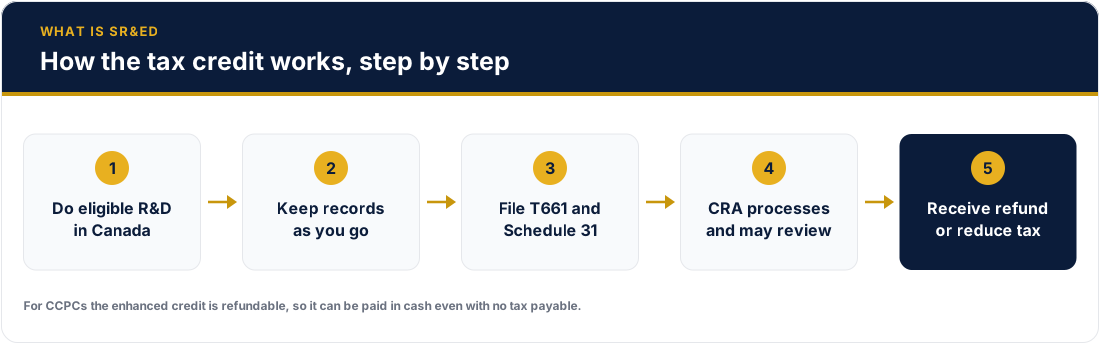
No. SR&ED is a tax credit, not a grant. You don't apply before doing the work; you do the work, then claim credits on your tax return for eligible expenditures.
For CCPCs, the enhanced credit is refundable, so it can be paid in cash — which is why many people think of it as an SR&ED grant. The practical difference matters: there is no application window, no competition for funds and no approval to wait for. If the work qualifies and the claim is filed on time, the credit is yours. The trade-off is that nobody tells you in advance whether you were right about eligibility.
Who can claim SR&ED
Corporations, individuals, partnerships and trusts carrying on business in Canada can all claim SR&ED. The most generous treatment is reserved for Canadian-controlled private corporations, which are the only claimants that can earn the enhanced refundable credit on their full expenditure limit.
There is no size threshold and no minimum spend. A two-person company that ran one genuine experiment can claim; so can a company with hundreds of engineers. What changes with size is the rate: once prior-year taxable capital climbs past $15 million the enhanced limit starts to shrink, and past $75 million it is gone entirely.
How much is the SR&ED tax credit?
| Claimant | Federal credit |
|---|---|
| CCPC, on up to $6M of qualified expenditures | 35%, refundable |
| CCPC, above the limit | 15% |
| Other corporations | 15%, non-refundable |
Eligible Canadian public corporations (ECPCs) can now also access the enhanced 35% rate. The expenditure limit is phased out for taxable capital between $15 million and $75 million, so larger companies keep partial access before losing it entirely. Most provinces add their own R&D credits on top of the federal credit, which can make a meaningful difference to the total.
At the enhanced rate the ceiling works out to a maximum refundable federal credit of $2.1 million a year. The number most companies care about, though, is not the ceiling — it's that a 35% refundable credit turns a meaningful share of an engineering payroll into cash that arrives without giving up equity.
These rates changed recently — see what Bill C-15 means for your business for the detail.
What work qualifies
Eligible work is a systematic investigation or search in a field of science or technology, carried out by experiment or analysis. In practice CRA asks whether there was a technological uncertainty, whether you formed hypotheses to resolve it, whether you tested them systematically, whether the goal was an advancement, and whether you kept records as the work progressed.
Failure is not disqualifying — an experiment that proves an approach won't work is still eligible. What is disqualifying is routine work: applying known methods, standard testing, and development that a competent professional could have done from published knowledge. Our SR&ED eligibility assessment page explains each question in full.
SR&ED examples by industry
SR&ED is claimed across the economy, not only in laboratories:
- Software and SaaS: novel algorithms, architectures with no established solution, and performance targets that existing libraries and techniques can't reach.
- Manufacturing and hardware: new production processes, materials and tooling, and prototypes built to test whether an approach works at all.
- Life sciences and medicine: formulation and device development, assay and process development, and the experimental work behind them.
- Clean technology: energy, emissions and materials work where efficiency or durability targets can't be met with known methods.
Which costs qualify
A claim is built from salaries and wages for employees directly engaged in SR&ED, materials consumed or transformed in the work, 80% of payments to arm's-length contractors performing SR&ED in Canada on your behalf, third-party payments to approved organizations, overhead through either the proxy or the traditional method, and — since Bill C-15 — capital expenditures again. The SR&ED eligible expenses page covers each category and how it's calculated.
How to claim SR&ED
You claim SR&ED by filing Form T661 and Schedule 31 with your tax return, within 12 months of its filing due date. The T661 holds the technical description of each project and the expenditure calculation; Schedule 31 applies the credit rates.
Individuals carrying on business file the T661 with their income tax return and Form T2038(IND), and partnerships file it with their partnership information return. In every case the claim travels with the tax filing for the year the work was done — there is no separate SR&ED application.
The deadline is the part worth writing down, because a late claim cannot be made at all. Our T661 form guide walks through each part of the form, the project-description word limits and how the deadline is calculated.
What happens after you file
CRA processes the claim and may review it. A review is routine rather than an accusation: a Research and Technology Advisor looks at whether the work meets the definition of SR&ED, and a Financial Reviewer looks at the costs. Claims supported by records made while the work happened tend to move quickly.
This is the part of the program companies underestimate. Nobody approves your projects before you start, so the evidence you keep while working is what settles the question later. Tickets, commits, test results, design notes and lab notebooks created at the time are worth more than any document written afterwards, because they could not have been shaped to fit the claim.
If your claim is selected, our SR&ED audit and CRA review support page explains the stages, from the first letter through to a notice of objection.
SR&ED vs IRAP
IRAP — the National Research Council's Industrial Research Assistance Program — provides advisory services and funding that you apply for in advance. SR&ED is a tax credit you claim after the work is done. One is approved before you spend; the other is claimed after.
Many companies use both. The thing to plan for is the interaction: IRAP funding for the same work reduces the SR&ED claim, so the two need to be coordinated rather than counted twice.
Recent changes under Bill C-15
- The expenditure limit doubled from $3 million to $6 million
- The maximum refundable credit increased from $1.05 million to $2.1 million
- The taxable capital phase-out moved to $15 million to $75 million
- Eligible Canadian public corporations became eligible for the enhanced rate
- Capital expenditures are eligible again for property acquired on or after December 16, 2024
Together these are the most significant changes to the program in over a decade, and they change the arithmetic for mid-sized and capital-intensive companies in particular. The full detail is in our post on what Bill C-15 means for your business, and the capital side is covered in capital equipment is SR&ED-eligible again.
If you're an early-stage company, the startup guide covers the criteria that decide what your claim is worth. For shorter answers to common questions, see the SR&ED FAQ.
SR&ED Questions, Answered
Wondering what your R&D is worth?
A short conversation is usually enough to tell whether you have a claim worth making. Or start with the estimator for a quick first number.