R&D Tax Credit Qualification Criteria for Startups in Canada
What your company has to be, what your work has to look like, and what early-stage companies get wrong often enough to cost them real money.
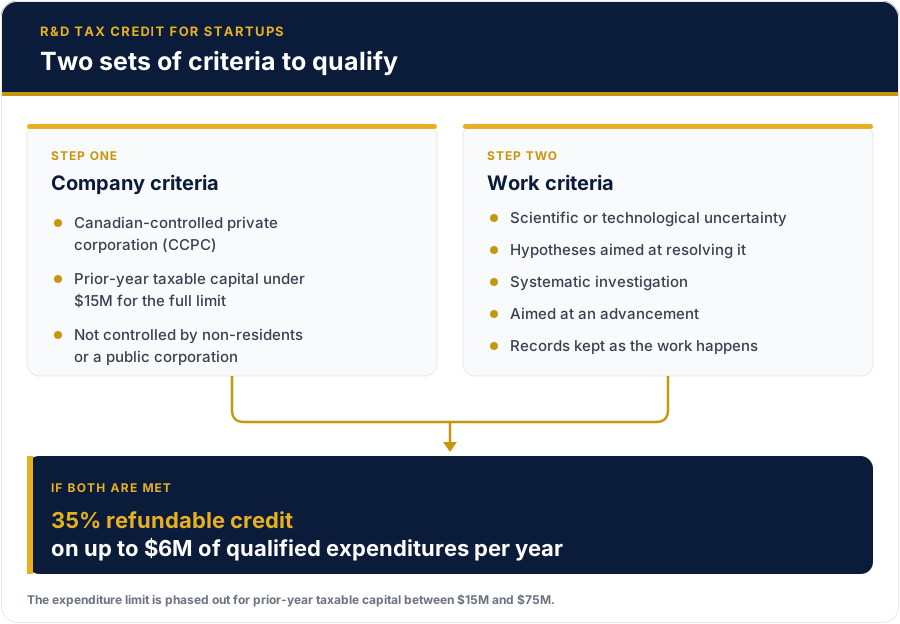
Canada's R&D tax credit program, SR&ED, is one of the few sources of non-dilutive cash available to early-stage companies, and it can pay out even before you have revenue. To qualify, a startup has to meet two sets of criteria: the company criteria and the work criteria.
The R&D tax credit qualification criteria for startups are simple to state and easy to get wrong. One set is about what your company is — where it is incorporated, who controls it, how big it has become. The other is about what your team actually did, which is judged project by project and has nothing to do with your industry or anyone's job title.
Both have to hold. A Canadian-controlled startup doing routine development has no claim. A team doing genuine experimental work inside a foreign-controlled subsidiary has a claim, but a much less valuable one. Knowing which situation you are in is worth doing early, because most of what makes a claim strong happens while the work is being done, not at filing time.
The company criteria
Canadian-controlled private corporations (CCPCs) can earn a 35% refundable federal investment tax credit on up to $6 million of qualified SR&ED expenditures per year, increased from $3 million under Bill C-15.
Refundable is the word that matters most for a startup. It means the credit is paid in cash even if the company has no taxable income — which describes almost every company in its first few years. A non-refundable credit only reduces tax you owe, so for a pre-revenue company it is worth nothing until it is profitable.
The expenditure limit is phased out when prior-year taxable capital, including associated companies, is between $15 million and $75 million. Most startups are nowhere near that range, but it is worth watching after a large round, and the associated-company rule means a parent or sister company's capital counts too.
Startups controlled by non-residents or by public corporations are not CCPCs. They can still claim SR&ED, but they generally earn a 15% non-refundable credit instead. If you are a Canadian subsidiary of a US parent, this is the single biggest factor in what your claim is worth, and it is decided by your share structure, not by where your engineers sit.
Two practical notes. First, CCPC status is tested on facts about control, so a financing round that changes who controls the company can change the answer for that year — worth raising with your accountant while the term sheet is still a draft, not after closing. Second, the associated-company test looks at the group, so a startup that is small on its own may still be grouped with a larger related company.
The work criteria
The second set of criteria is about the work itself. CRA asks five questions about each project, and in plain language they come down to this:
- Uncertainty. Was there something you genuinely did not know how to do, that standard practice and available knowledge could not tell you?
- Hypotheses. Did you form specific ideas about how to resolve that uncertainty, rather than trying things at random?
- Systematic investigation. Did you test those ideas through experiment or analysis, in a way someone could follow?
- Advancement. Were you trying to move the technology forward, not just build a product out of known parts?
- Records. Did you keep a record of what you tested and what happened, while the work was going on?
Note what is not on the list: difficulty, cost, how long it took, or whether it worked. Failed experiments qualify. Projects that got cancelled qualify for the work done. What does not qualify is applying known methods competently, however new they were to your team.
At an early-stage company the eligible work is usually easy to find once you know what you're looking for, because it's whatever the team got stuck on. The month spent trying to make a model accurate enough on the data you actually had. The rewrite forced by a latency target the obvious architecture couldn't hit. The process that worked in the lab and failed at production volume. Those are candidates. The sprint that delivered the billing page is not, however hard the quarter felt.
One more thing founders get wrong: eligibility is judged per project, not per company. A startup can have one strongly eligible project running alongside three that aren't, and claiming only the first is the right answer — not a sign that something went wrong.
Our SR&ED eligibility assessment page works through the five questions in full, and the post on what qualifies for SR&ED in software companies applies them to real engineering examples.
What startups typically claim
The cost side of a startup claim is usually straightforward, because most of the money went to people:
- Salaries of developers, engineers and scientists, for the portion of their time spent on SR&ED
- 80% of arm's-length contractor costs for SR&ED work performed on your behalf in Canada
- Materials consumed in experiments
- Overhead through the proxy method, which adds a prescribed amount based on the eligible salary base rather than making you track actual overhead costs
For a software startup, salaries plus proxy overhead is often the entire claim. That makes payroll accuracy and time allocation the two things worth getting right. A defensible allocation doesn't require a timesheet system — it requires a reason. If you can point at the projects a person worked on and the records that show it, a reasonable split holds up; a round number chosen at filing time does not.
Our SR&ED eligible expenses page covers all six categories and how each is calculated.
Mistakes that cost startups money
- Paying founders only in dividends. Dividends can't be claimed as an SR&ED expense; salaries can. Founders are often the people doing the most experimental work, and paying them entirely in dividends can remove the largest piece of the claim.
- Not tracking time or keeping records while the work happens. Reconstructing a year of projects from memory produces a weak claim and a long review. Tickets, commits and test results created at the time cost nothing extra and are the strongest evidence you can have.
- Not deducting grants such as IRAP funding. Assistance for the same work reduces your qualified expenditures. Leaving it in doesn't get you a bigger refund; it gets the claim adjusted.
- Missing the filing deadline. The claim must be filed within 12 months of the corporate tax return's due date. There is no appeal for a late claim — the year is simply gone. See the T661 form guide for how the deadline is calculated.
- Claiming routine development as SR&ED. Padding a claim with ordinary feature work invites adjustments in review and casts doubt on the projects that genuinely qualify.
Where to start
If you have never claimed before, the useful first step is not paperwork. It is a short conversation about what your team has been stuck on, because that is where eligible work lives. From there you will know whether there is a claim worth making, and what to start recording so the next one is stronger.
For background on the program itself, start with what SR&ED is. If you already know you qualify and want to understand the form, go to the T661 form guide. Either way, it costs nothing to ask — the SR&ED FAQ covers the questions founders ask most.
Startup SR&ED Questions, Answered
Not sure whether your work qualifies?
Tell us what your team has been building and we'll tell you where you stand. Or run the numbers yourself first with our free estimator.