SR&ED Audit and CRA Review Support
From the first letter to a proposal response or objection — support from someone who has read these claims from the other side of the table.
An SR&ED audit — a CRA review of your claim — is a normal part of the SR&ED program, not an accusation. CRA reviews a share of claims every year, including good ones. But how you prepare and respond affects the outcome. We help you prepare, present your work clearly and respond to CRA's findings.
The difference between a short review and a long one is rarely the quality of the R&D. It is whether the company can show, on request, what it was uncertain about, what it tried, and what happened — in records created at the time.
Most companies meet their first review with the claim already filed and the engineers who did the work busy on something else. That is a solvable problem, but only if it is handled deliberately: deciding what evidence exists, who will present it, and what the reviewer is actually trying to establish at each stage.
What happens in a CRA SR&ED review
- CRA contacts you by letter. A Research and Technology Advisor reviews the technical side and a Financial Reviewer reviews the costs; one or both may be involved.
- CRA requests information and usually holds a meeting, on site or virtually, with the people who did the work.
- If CRA proposes changes, it sends a proposal letter explaining its position, usually with 30 days to respond.
- CRA issues a notice of reassessment.
- If you disagree, you can file a notice of objection within 90 days of the date on the notice of reassessment, and appeal further to the Tax Court of Canada.
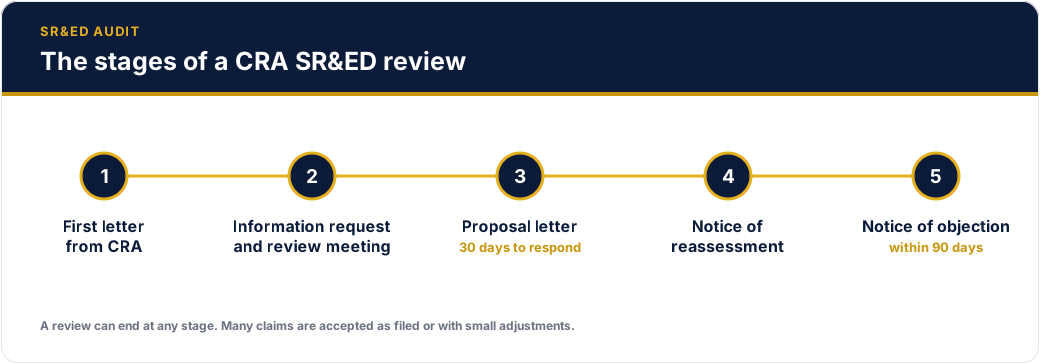
A review can end at any of these stages. A proposal letter is not a decision — it is CRA setting out its position and inviting a response. The 30 days it gives you are the single most valuable window in the process, and the easiest one to waste.
The meeting in stage two matters more than most companies expect. CRA wants to hear from the people who did the work, not from a representative reading a summary. Engineers who can walk through what they were trying to do, where it failed and what they changed are the strongest evidence a claim has — provided they know what they are being asked and why.
What a strong response looks like
A good response answers the question CRA actually asked. That sounds obvious, and it is the thing most responses get wrong: they restate the project narrative at greater length instead of pointing at the evidence the reviewer said was missing.
Because the technical and financial sides are reviewed by different people — a Research and Technology Advisor for the work, a Financial Reviewer for the costs — a response often needs to do two separate jobs. The technical half shows the uncertainty, the hypotheses, the experiments and the results, each tied to a document created at the time. The financial half shows how the hours and dollars were arrived at and that they match the projects described.
Timing is part of the answer too. If the 30 days in a proposal letter is not enough to gather what you need, the extension is asked for before the deadline passes, not after.
How we help
We work alongside your team and your accountant, taking on the parts of a review that are hardest to do while also running a company:
- Preparing for the review meeting — going through the claim as the reviewer will, and finding the gaps before they do
- Organizing technical and financial evidence so each project's uncertainty, experiments and results can be shown in minutes, not searched for
- Preparing your team to explain the work — engineers are usually the strongest witnesses to their own experiments once they know what is being asked and why
- Attending meetings as your authorized representative
- Writing responses to information requests and proposal letters, answering CRA's stated position point by point with evidence attached
- Supporting a notice of objection in coordination with your accountant or tax lawyer
We can step in at any stage, including after a proposal letter has already arrived, and regardless of who prepared the original claim. The earlier we are involved the more options there are, but a late start is better than a missed deadline.
Most of what gets argued in a review traces back to documentation. Our post on the five most common SR&ED documentation mistakes covers what reviewers tend to find missing. If you would rather settle eligibility before filing at all, CRA's Pre-Claim Approval Process is worth a look.
Why a former reviewer's view matters
Kazem Naderi, a former CRA SR&ED Claims Reviewer, has seen reviews from the reviewer's side and knows how reviewers read claims and what evidence they look for. That changes what we do with your file: which sentence in the T661 is going to draw a question, which document answers it, and which argument is worth making in writing rather than in a meeting.
His insight comes from how reviews are conducted, never from confidential information about any company. We don't promise a result — nobody can, and you should be careful of anyone who does. What we can do is make sure the work your team actually did is the thing CRA ends up assessing.
If the review is also questioning your costs, the cost side of the claim usually needs reconciling at the same time. And for next year, an eligibility assessment before you file is the cheapest audit preparation there is. See all our SR&ED consulting services.
Related guides: the T661 form guide, including the mistakes reviewers see most, and What is SR&ED?
SR&ED Audit Questions, Answered
Got a letter from CRA?
Send us the letter and your claim. We'll tell you what the reviewer is asking for, what evidence you already have, and what the next 30 days should look like.
Talk to a Former CRA Reviewer