SR&ED Eligibility Assessment
Know which projects are strong candidates, which are not, and what evidence to strengthen — before you build a claim around them.
SR&ED eligibility depends on the work you did, not on your industry or job titles. An eligibility assessment tells you which projects are strong candidates, which are not, and what evidence is missing, before you invest time in a claim.
Two companies in the same business can get opposite answers. A team that hit a technical problem it could not solve with known methods, worked through it experiment by experiment and left a trail behind has a claim. A team that applied established methods well and shipped on schedule does not, however hard that work was.
That is why the assessment belongs at the start. You end up with a project-by-project picture: what clearly qualifies, what is borderline and why, and what to start recording now so this year's work holds up.
It also tells you what not to spend time on. Writing up a project that was never going to qualify costs your engineers hours they don't have, and puts a weak project in front of a reviewer next to your strong ones.
What CRA looks for
SR&ED is defined in subsection 248(1) of the Income Tax Act as a systematic investigation or search carried out in a field of science or technology by means of experiment or analysis. CRA turns that definition into five questions, set out in its Eligibility of Work for SR&ED Investment Tax Credits Policy, and asks them about each project:
- Was there a scientific or technological uncertainty?
- Did the effort involve formulating hypotheses specifically aimed at reducing or eliminating that uncertainty?
- Was the overall approach consistent with a systematic investigation or search, including formulating and testing the hypotheses by means of experiment or analysis?
- Was the overall approach undertaken for the purpose of achieving a scientific or technological advancement?
- Was a record of the hypotheses tested and the results kept as the work progressed?
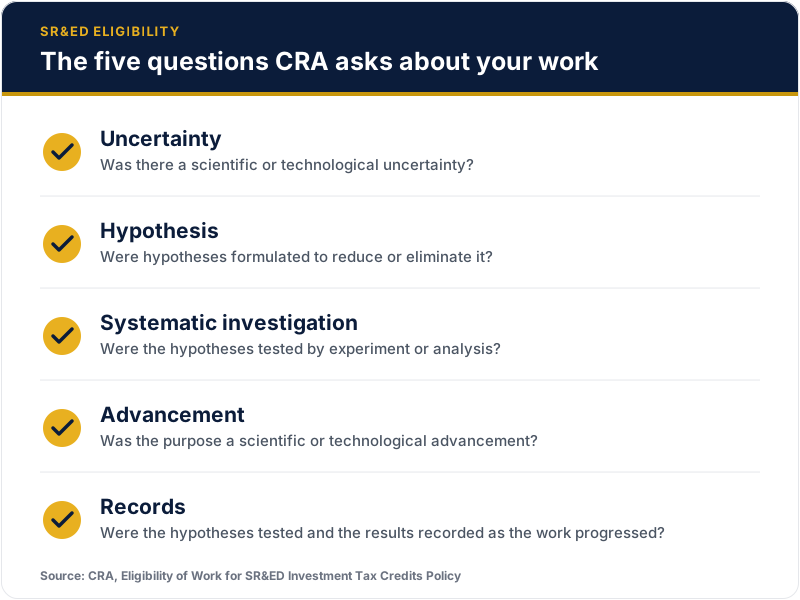
The questions work together. A project that clears the first four and fails the fifth — genuine experimentation with no record of it — is one of the most common reasons a claim gets cut back. Notice what CRA does not ask: whether the work was difficult, expensive, or commercially important. It asks whether the work was a systematic search for an advancement, and whether you can show it.
Our post on what qualifies for SR&ED in software companies walks through the same test using real engineering examples.
Work that does not qualify
The Income Tax Act excludes a list of activities from SR&ED, even when they are technical and essential to the business:
- Market research or sales promotion
- Quality control or routine testing of materials, devices, products or processes
- Research in the social sciences or the humanities
- Prospecting or exploring for minerals, petroleum or natural gas
- Commercial production
- Style changes
- Routine data collection
Routine engineering that applies known methods also doesn't qualify. If a competent professional in the field could have reached the solution from published knowledge, standard practice or product documentation, the work is not SR&ED — even if nobody on your team had done it before. Learning something new to your company is not the same as advancing the technology.
Most of the claims that get reduced are not dishonest. They describe a product instead of an uncertainty: what was built, how well it performs, how long it took. The assessment is where that gets caught, while there is still time to fix it.
How the assessment works
- A conversation about your technical challenges and projects. We talk to the people who did the work — not only finance — about what you were trying to achieve, where the approach broke down, and what you tried next.
- A review of project records. Tickets, commits, branches, test results, design documents, lab notes and meeting notes. We are looking for the trail that shows the investigation happened, and for the places where that trail goes quiet.
- Written findings. Project by project: strong candidate, borderline, or out of scope, with the reasoning attached to each one and a note on the evidence that would make a borderline project defensible.
- Next steps. Either preparing the claim, or tightening documentation for the year in progress so the next claim is stronger than this one.
Knowing early matters more than it used to. Bill C-15 doubled the enhanced expenditure limit and brought capital expenditures back into the program, so a qualifying year is worth more than it was — and a year of unrecorded work costs more. Once the technical picture is settled, the cost side of the claim decides how much of it comes back.
Why a former reviewer's view matters
Kazem Naderi spent years reviewing SR&ED claims as a CRA SR&ED Claims Reviewer and brings 28+ years of software industry experience. He assesses projects the way a reviewer will read them: which sentences invite a question, which claims need a document behind them, and which strong technical work has been described in a way that hides the uncertainty.
His insight comes from how reviews are conducted, never from confidential information about any company. That distinction matters. What you get is judgment about evidence and argument — the same judgment that decides how a CRA review goes if your claim is selected for one.
An assessment does not promise an outcome, and no one can. What it does is replace a guess with a clear read on where your projects stand and what would make them stronger. More answers are on our SR&ED FAQ, or see the full range of SR&ED consulting services.
Related guides: What is SR&ED? and the R&D tax credit criteria for startups.
SR&ED Eligibility Questions, Answered
Find out where you stand
Bring us your projects and we'll tell you which ones are worth claiming, which ones are not, and what to record from here. No obligation to file a claim with us.
Book a Free Eligibility Call