T661 Form: A Practical Guide to Your SR&ED Claim
What each part of the form is actually asking for, how to write project descriptions that answer it, and the deadline you cannot miss.
Form T661, "Scientific Research and Experimental Development (SR&ED) Expenditures Claim", is the form corporations use to claim SR&ED. It's filed with the T2 corporate income tax return, together with Schedule 31, which calculates the investment tax credit.
The T661 form is where the claim actually gets made. Everything else — the projects, the records, the time your engineers spent — only counts to the extent it ends up described accurately on this form, inside its word limits, before its deadline.
This guide walks through what each part asks for and where claims tend to go wrong. It is written from the perspective of someone who used to read these forms at CRA, which mostly means it pays attention to the parts reviewers actually test.
What the T661 asks for
For all its length, the form asks for four things, and only two of them take real effort:
- The claimant's general information — who is claiming, and for which tax year
- Project information — the technical narrative for each project you are claiming
- The calculation of SR&ED expenditures, including your choice of the proxy or traditional overhead method
- Information about anyone who helped prepare the claim and how they were paid
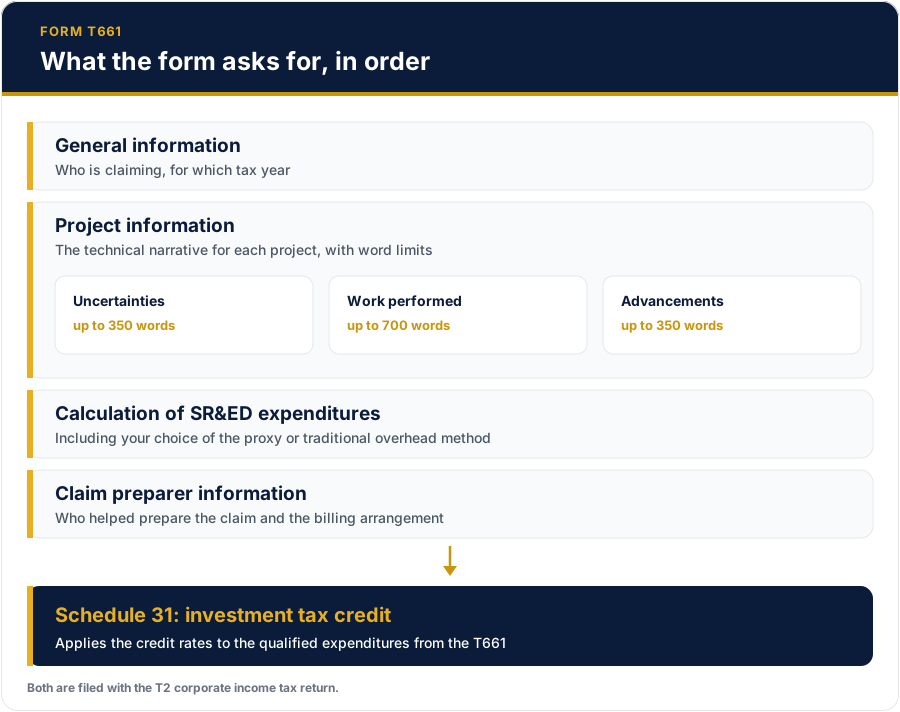
The two halves that matter are the project descriptions and the expenditure calculation, and they are read by different people. A Research and Technology Advisor assesses the technical narrative; a Financial Reviewer assesses the costs. If the two halves describe different work, that gap is the first thing a review will find.
The expenditure section is also where you elect your overhead method for the year — proxy or traditional. The proxy method adds a prescribed amount calculated from the eligible salary base instead of making you identify actual overhead costs, which is why most smaller claimants choose it. The election is made for each tax year, so it is a decision you revisit rather than set once.
Writing the project descriptions
For each project, the technical narrative answers three questions, each with a word limit:
- What scientific or technological uncertainties did you try to overcome? (up to 350 words)
- What work did you perform in the tax year to overcome them? (up to 700 words)
- What scientific or technological advancements did you achieve or attempt? (up to 350 words)
The limits are generous if you answer the question, and far too short if you tell the story of the product. Most weak narratives are weak because they spend the words on the wrong thing.
The uncertainties
Describe the technological problem, not the business feature. "Customers needed faster search results" is a business goal. "We could not determine whether an index could be maintained within our write-latency budget at the data volumes involved, because the available indexing approaches assumed a read-heavy workload" is a technological uncertainty.
The test a reviewer applies is whether the problem could have been resolved by someone competent in the field using published knowledge and standard practice. If it could, there is no uncertainty — however much work the project took.
The work performed
This is where the hypotheses and the tests go. Each uncertainty should lead to specific things you believed might resolve it, the experiments or analyses you ran to find out, and what the results were. Dates, versions and measurements help; adjectives don't.
You have 700 words, so be selective. Three clearly described iterations beat a list of twenty activities. Every claim in this section should have something behind it in your records — a ticket, a commit, a test result, a notebook entry — because this is the section a review will ask you to evidence.
The advancements
Describe what was learned, even if the result was negative. Establishing that an approach cannot meet a requirement is an advancement in your company's technological knowledge, and it is eligible. Claims are weakened, not strengthened, by implying everything worked.
Advancement is measured against the knowledge available to your company, not against the whole industry. If a competitor solved a similar problem but kept the method confidential, working it out yourselves can still be an advancement.
Claim preparer information
If a consultant or other third party helped prepare the claim, the T661 asks for their details and the billing arrangement, including contingency fees. A penalty of $1,000 can apply if this information is missing or incomplete.
This part is easy to overlook and easy to complete. Ask whoever prepared your claim for their information before filing rather than after — and if nobody outside the company was involved, say so, rather than leaving the section blank.
The T661 filing deadline
The T661 and Schedule 31 must be filed within 12 months of the T2 return's filing due date. For most corporations, that's about 18 months after the end of the tax year. Missing it means losing the claim for that year.
This deadline is absolute in a way most tax deadlines are not. There is no late-filing version of an SR&ED claim: once the date passes, the expenditures for that year can no longer be claimed, no matter how strong the projects were. If your year ends in December, the practical effect is that work you did in a given year has to be documented well enough to describe roughly a year and a half later.
You can amend a T661 while you are still inside that window — adding a project you missed, correcting a calculation — but once the 12-month reporting deadline passes, no new SR&ED expenditures can be added for that year. In practice this means filing early enough that an amendment is still possible is worth more than filing a perfect claim at the last moment.
Mistakes reviewers see most
- Describing business features or goals instead of the technological uncertainty. The most common reason a strong project reads as ineligible.
- Narratives that don't match the costs claimed. Hours claimed for people and projects the narrative never mentions, or a large claim attached to a short description.
- Claiming routine development or testing. Configuration, integration as documented and standard QA don't qualify on their own, and including them invites scrutiny of everything else.
- Not deducting grants and other assistance. Assistance for the same work reduces qualified expenditures and has to be deducted in the right place.
- Incomplete claim preparer information. A $1,000 penalty for a box that takes a minute to complete.
- Filing close to the deadline with no time to fix problems. Questions that could be answered in a week become a lost year when there is no week left.
Our post on the five most common SR&ED documentation mistakes covers the records side of this in more detail.
Before you file
Two checks are worth the time. First, confirm the projects belong in the claim at all — an eligibility assessment settles that before you write anything. Second, confirm the numbers and the narrative agree, which is the heart of cost calculation and the thing most likely to be tested if CRA reviews the claim.
New to the program? Start with what SR&ED is. Early-stage company? The startup guide covers the criteria that decide what your claim is worth.
T661 Questions, Answered
Want a second pair of eyes on your T661?
We prepare and review T661 claims for Canadian companies, and we read them the way a CRA reviewer will. Start with a free consultation, or size up the claim yourself first.