SR&ED Eligible Expenses and Cost Calculation
Every eligible cost identified, calculated correctly, and tied back to the projects your claim describes.
An SR&ED claim has two halves. The technical side decides whether your work qualifies. The cost side — your SR&ED eligible expenses — decides how much of it comes back. We identify every eligible expense, calculate it correctly and connect each cost to the projects described in the claim.
Both halves get read. A strong technical narrative attached to a cost schedule that nobody can tie back to it is the fastest way to turn a straightforward claim into a long review.
What counts as an eligible SR&ED expense
Six categories make up a claim. For most companies the salary base is by far the largest, and everything else — including the overhead calculation — follows from how accurately that base is built.
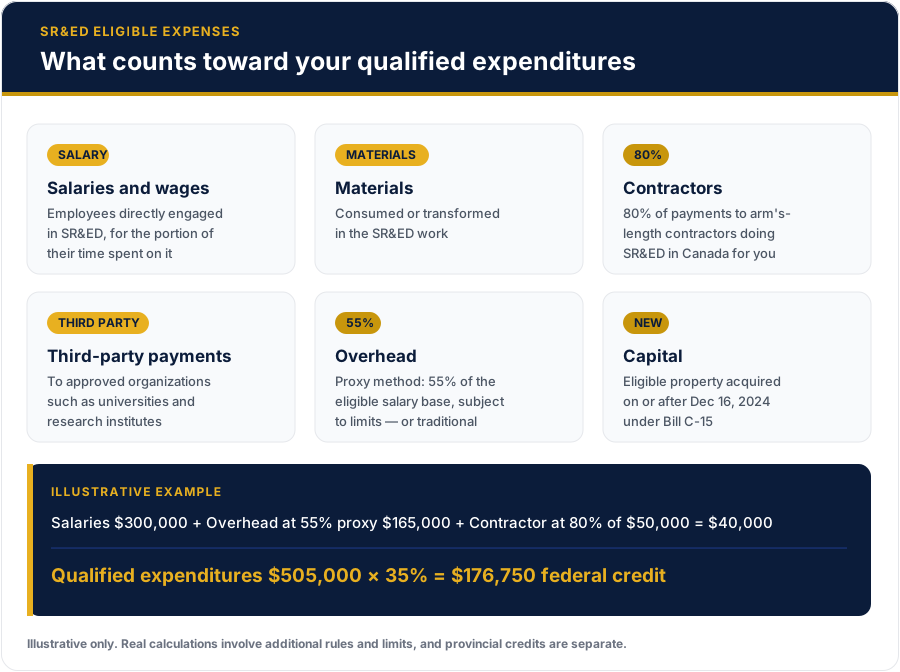
- Salaries and wages of employees directly engaged in SR&ED, for the portion of their time spent on it
- Materials consumed or transformed in SR&ED
- Contracts: 80% of payments to arm's-length contractors performing SR&ED on your behalf in Canada
- Third-party payments to approved organizations such as universities and research institutes
- Overhead, using either the proxy method (a prescribed proxy amount equal to 55% of the eligible salary base, subject to limits) or the traditional method of identifying actual overhead costs
- Capital expenditures, restored for eligible property acquired on or after December 16, 2024 under Bill C-15
The categories are simple to list and easy to get wrong in practice. The hard part is the boundary: which hours inside a project were SR&ED and which were production work, which materials were consumed in the experiment and which went into saleable product, which contractor did SR&ED on your behalf and which delivered a routine build.
Where cost claims go wrong
The errors we see most often are not aggressive positions. They are ordinary bookkeeping decisions that don't survive a look at the rules:
- Dividends treated as compensation. Founders paid in dividends rather than salary have no salary to claim, however much SR&ED work they personally did. Dividends are not salary and can't be claimed as an SR&ED expense.
- Specified employees handled like everyone else. Special limits apply to people who own 10% or more of the company's shares, and they have to be applied before the overhead proxy is calculated.
- Contractor payments claimed in full. It is 80% of payments to arm's-length contractors performing SR&ED on your behalf in Canada — and the contractor can't also claim the same work.
- Assistance left in. Government and non-government assistance for the same work, such as IRAP funding, reduces qualified expenditures. If it isn't deducted correctly, CRA will adjust the claim.
- Time allocations with nothing behind them. A round number like "60% of engineering" is a position you will have to defend. A reasonable allocation tied to projects and people is one you can.
What it's worth after Bill C-15
Canadian-controlled private corporations (CCPCs) can earn a 35% refundable federal investment tax credit on up to $6 million of qualified SR&ED expenditures per year, up from $3 million. The expenditure limit is phased out for taxable capital between $15 million and $75 million.
Expenditures above the limit, and those of most other corporations, earn a 15% non-refundable federal credit. Eligible Canadian public corporations (ECPCs) can now also access the enhanced 35% rate. Most provinces offer their own R&D credits on top of the federal credit.
Refundable is the word that matters for a company still investing ahead of revenue: the credit can be paid in cash rather than carried forward against tax you don't owe yet. Our post on what changed under Bill C-15 covers the new limits in full.
A worked example
This example is illustrative. It shows how the pieces fit together, not what your company would receive.
A CCPC pays $300,000 in salaries for SR&ED work and elects the proxy method, which adds $165,000 ($300,000 × 55%). It also pays an arm's-length contractor $50,000, of which 80% — $40,000 — counts.
Qualified expenditures: $505,000. Federal credit at 35%: $176,750, before provincial credits.
Real calculations involve additional rules and limits. The example assumes every salary dollar was for work directly engaged in SR&ED, no assistance was received, and the company is within its expenditure limit — three assumptions that each need to be checked against your records before they hold.
How we calculate your claim
- Map people's time to projects. Who worked on which project, for what share of the year, and on which parts of it. This is where most of the value sits, and where most of the questions come from.
- Collect payroll, invoices and material records. T4 data, contractor agreements and invoices, purchase records for materials consumed or transformed, and acquisition records for capital property.
- Choose the overhead method. Proxy or traditional, elected on Form T661 for the year. We calculate both where the answer isn't obvious and show you the difference.
- Deduct government and non-government assistance. IRAP, grants and similar funding for the same work reduce qualified expenditures, and the deduction has to be in the right place.
- Reconcile with the project descriptions. The hours claimed, the people named and the work described all have to agree, so the technical and financial sides of the claim tell the same story.
That last step is the one most often skipped, and the one a reviewer tests first. If your claim is selected, a reconciled cost schedule is what makes a CRA review short. If you are not yet sure which projects belong in the claim at all, start with an eligibility assessment — or see all our SR&ED consulting services.
Related guides: the T661 form guide, which covers where these costs are reported, and the R&D tax credit criteria for startups.
SR&ED Expense Questions, Answered
Find out what your R&D is worth
Send us your projects, payroll and contractor records and we'll build the cost side of your claim — and show you exactly how each number was arrived at.
Book a Free Consultation